
Christmas chocolate traditions around the world: how people enjoy chocolate in Czechia, Germany, Belgium, France, Italy and Britain
Christmas smells of cinnamon, fir and – almost everywhere in Europe – chocolate. Christmas chocolate traditions differ from country to country, though: in some places Advent is counted down window by window, in others a sweet log is baked, and elsewhere a Saint Nicholas figure is tucked into a shoe. Let’s travel across Europe and see how people enjoy chocolate over the holidays in Czechia, Germany, Belgium, France, Italy and Britain – and how you can bring a little of that home.

Chocolate at Christmas: why it belongs to the holidays
Chocolate suits the winter holidays for three practical reasons. First, it pairs with seasonal flavours – cinnamon, nuts, citrus and baked goods. Second, it wraps and gifts well: a bar, a box of pralines or a figure fits under the tree and into a small parcel. Third, it works as a small ritual. Opening a window, unwrapping a box or breaking a square from a shared bar is a gesture that returns every year.
Chocolate at Christmas is therefore more than a sweet. It is a way to slow Advent down and make waiting tangible. That is why you find it in Advent calendars, Saint Nicholas treats and festive gift sets.
Czechia: Saint Nicholas treats, biscuits and Christmas chocolate under the tree
In Czechia the sweet season starts before Christmas itself. Saint Nicholas’s Day falls on 6 December, but Mikuláš (Saint Nicholas), an angel and a devil traditionally visit on the evening before, 5 December. Children receive small treats – fruit, nuts, gingerbread biscuits and often chocolate. Where Mikuláš does not come in person, children sometimes leave a stocking or a shoe by the window overnight.
Christmas itself belongs to baking biscuits, the Christmas Eve table and gifts under the tree. Chocolate plays a double role: it is part of the biscuits (coatings, pralines, assortments) and a popular gift. A festive mood is easy to underline with Christmas chocolate spiced like gingerbread – for example Christmas Gingerbread Chocolate in the dark version, or the milk Christmas Gingerbread Chocolate.

Germany and Austria: the Advent calendar and the art of counting down
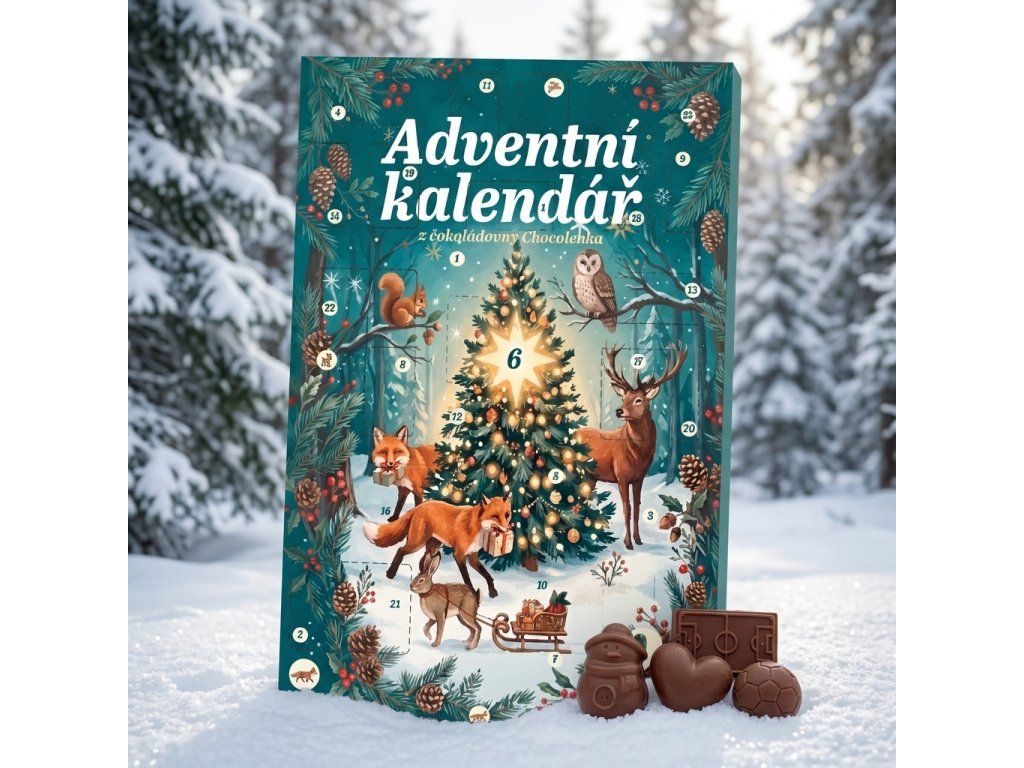
In German-speaking countries the symbol of Advent is the Advent calendar. The custom of counting down the days to Christmas grew in the 19th century in Protestant households; printed calendars spread at the beginning of the 20th century. The Munich publisher Gerhard Lang is often linked with the first commercial calendars. Filling the windows with sweets was already tried in the first half of the 20th century, but widely available chocolate Advent calendars mainly took off after the Second World War.
Today a chocolate Advent calendar is common from Germany through Austria and far beyond their borders. The principle is the same: one window a day, a small joy and the feeling that Christmas is coming closer. If you want this tradition at home, you can choose a ready-made calendar from the Advent calendars category, or put together your own filled with pralines and pieces of chocolate.
Belgium and Switzerland: pralines and chocolate figures
Belgium is a byword for pralines and festive chocolate figures. On 6 December, when Saint Nicholas (Sinterklaas / Saint-Nicolas) is celebrated, children often find chocolate figures, coins, speculoos biscuits and other sweets in their shoes. Pralines and gift boxes then belong to Christmas itself – as a treat for guests and as a gift that is easy to share.
In Switzerland a similar role belongs to Samichlaus. Around 6 December children receive a small bag of sweets, nuts and fruit; chocolate is a common part of it. Switzerland and Belgium are also countries where chocolate is a year-round craft – and Christmas is simply another moment when it takes centre stage.
Belgian inspiration is easy to bring home: a box of hand-made pralines from Chocolenka is enough. If you prefer smaller bites, take a look at Chocolate Medallions – check the product page for current availability.

France: the chocolate Yule log (bûche de Noël)
The chocolate Yule log – bûche de Noël in French – is a dessert that echoes the older custom of burning a large wooden log at Christmas. The edible version is commonly said to have appeared in Parisian pastry shops at the end of the 19th century: a sponge is rolled with cream and often coated in chocolate icing or ganache to look like bark. After the Second World War the bûche spread across France and today ranks among typical Christmas desserts.
You do not need to bake a log to nod to the tradition. It is enough to bring festive-looking chocolate to the table – for example a set you can share. Our Chocolate set – Christmas Present (gold) works as a small “festive platter” in a box.

Italy and Britain: festive sweets and chocolate gift boxes
In Italy Christmas belongs above all to panettone and pandoro – enriched yeast breads that today often appear in chocolate versions too – and to torrone, a nutty nougat. Chocolate joins the festive table as a dessert, a gift and part of the baking. It is not the only star of the holidays, but without it winter pastry shops would look noticeably poorer.
In Britain chocolate has another ritual: gift boxes and mixed chocolate selections (selection boxes and tins) that are opened at Christmas and shared in the family. The tradition reaches into the first half of the 20th century, and festive tins with assorted pralines and chocolates are as much a part of Christmas for many British families as the tree. The idea is simple: one box, many flavours, shared snacking.
If you want a similar effect at home, choose a set with several flavours – for example Christmas Surprise No. 1 – or a festive bar that breaks and shares well, such as Christmas Tree with hazelnuts.

Christmas customs around the world: how to bring them home
You do not need to travel to take something from European customs. Pick one ritual and keep it through Advent:
German style: one window every day – a ready-made Advent calendar, or a DIY calendar filled with pralines and pieces of bar.
Belgian style: a box of pralines on the table for guests, or a small figure or other sweet to share with tea.
French style: one festive chocolate centrepiece for the Christmas Eve table – a set or a striking bar.
British style: a shared box with several flavours, from which everyone chooses.
Czech style: a Saint Nicholas parcel on 5 December and chocolate under the tree on 24 December.
Whatever you choose, store chocolate in a dry place away from strong smells, usually at 18–23 °C – exact advice differs by product. Neither radiator heat nor the fridge does it any favours, and nutty or filled pieces especially appreciate a calm spot.

Conclusion: Christmas chocolate traditions in your own home
Christmas customs around the world show that chocolate can be a calendar, a gift, a dessert and a shared ritual. In Germany it counts the days, in Belgium and Switzerland it fills shoes and bags, in France it imitates a log, in Italy it joins festive baking and in Britain it opens from one large box. In Czechia it belongs to Saint Nicholas’s Eve and under the tree. Choose what suits you – and let chocolate slow your Advent down a little.
Start your own tradition this year: choose an Advent calendar, a festive bar from Christmas chocolates or a box of pralines from Chocolenka.